SBI and Visa Launch Crypto Reward Credit Cards in Japan, Expanding XRP, Bitcoin, and Ethereum Use in Everyday Consumer Payments
SBI partners with Visa to introduce crypto cashback cards in Japan, rewarding users with XRP, BTC, and ETH for daily purchases.
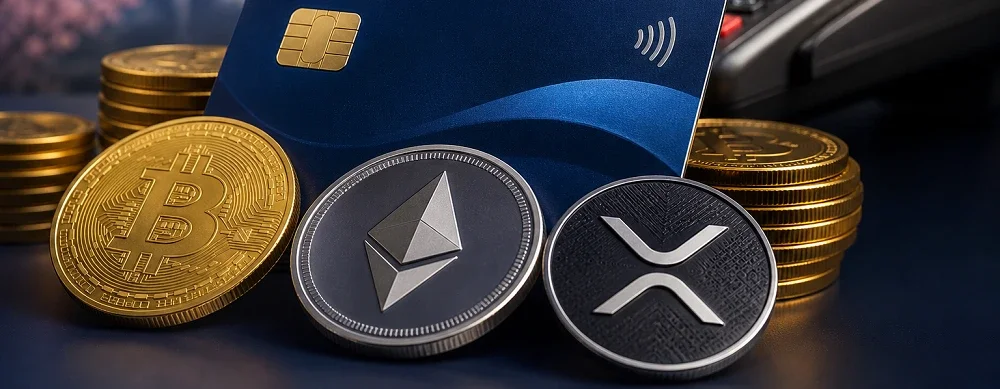
SBI Holdings has announced a strategic partnership with Visa to introduce crypto reward credit cards in Japan, marking another significant step toward integrating digital assets into mainstream consumer payments.
The initiative, confirmed by SBI Holdings Chairman and President Yoshitaka Kitao, allows cardholders to earn cryptocurrency rewards, including Bitcoin, Ethereum, and XRP, through everyday purchases.
The product is designed to simplify crypto adoption by combining traditional payment infrastructure with blockchain-based reward systems. Instead of relying on conventional cashback points, users receive digital asset rewards directly into supported crypto wallets, creating a seamless connection between daily spending and crypto ownership.
Under the program, standard cardholders can earn up to 2.5% in cryptocurrency rewards based on transaction volume and promotional conditions. Premium Gold card users may receive rewards of up to 10% depending on spending tiers and limited-time incentive structures.
The launch aligns with Japan’s broader transition toward digital-first payment systems, where cashless transactions continue gaining traction. By leveraging Visa’s established payment infrastructure and SBI’s expanding crypto ecosystem, the collaboration aims to lower barriers to entry for users unfamiliar with digital assets.
SBI has consistently positioned itself as one of Japan’s most active financial institutions in blockchain and cryptocurrency development. The company has maintained strong exposure to XRP as part of its long-term digital asset strategy, with its partnership history involving Ripple-related financial products and infrastructure.
This latest card initiative strengthens SBI’s wider ecosystem approach, where payments, crypto exchanges, and blockchain services are increasingly interconnected.
At the same time, SBI is reportedly exploring a potential acquisition and capital alliance with Bitbank, one of Japan’s major cryptocurrency exchanges. If completed, the move would further expand SBI’s influence across Japan’s digital asset market by strengthening its exchange infrastructure and liquidity channels.
The potential Bitbank deal reflects a growing trend of consolidation within Japan’s crypto sector, where established financial institutions are seeking greater control over infrastructure, customer acquisition, and market access.
Separately, Rakuten Wallet has also expanded its cryptocurrency integration, contributing to increased attention around XRP’s practical use in retail payments.
Rakuten’s ecosystem presents substantial scale. Its payment network, Rakuten Pay, reportedly serves approximately 44 million users across Japan, while its loyalty system holds around $23 billion worth of reward points in circulation.
Market participants view Rakuten’s crypto expansion and SBI’s Visa-backed card launch as meaningful developments for XRP’s broader adoption narrative.
For years, XRP has largely been viewed as a speculative or traded digital asset, with much of its market activity centered around exchange trading rather than consumer utility. However, expanding integration into real-world payment systems may gradually reshape that perception.
Industry analysts suggest that combining crypto rewards, exchange infrastructure, and consumer payment channels creates a stronger foundation for practical digital asset adoption.
For XRP specifically, these developments increase its visibility across multiple consumer touchpoints, from payment rewards and wallet deposits to exchange services and retail transactions.
Japan continues to stand out as one of the most regulated and innovation-friendly crypto markets globally, making it an important testing ground for mainstream digital asset adoption.
The SBI-Visa partnership highlights how traditional financial institutions are increasingly exploring ways to integrate crypto into everyday financial products without requiring major behavioral changes from consumers.
By embedding crypto rewards into familiar credit card spending habits, SBI and Visa may accelerate retail participation in digital assets while supporting broader financial innovation.
As adoption expands and infrastructure matures, Japan could become a leading example of how crypto rewards evolve from niche incentives into mainstream financial tools, with XRP positioned at the center of that transition alongside Bitcoin and Ethereum.
Source: https://coinpaper.com/16770/sbi-group-and-visa-lau