UK FCA Establishes Regulated Framework for Tokenized Funds, Enabling Onchain Records and Direct Dealing While Maintaining Strong Investor Pr
Policy PS26/7 Allows DLT-Based Fund Operations, Supports Stablecoin Settlement Exploration, and Advances UK Cryptoasset Framework Toward 2027 Launch
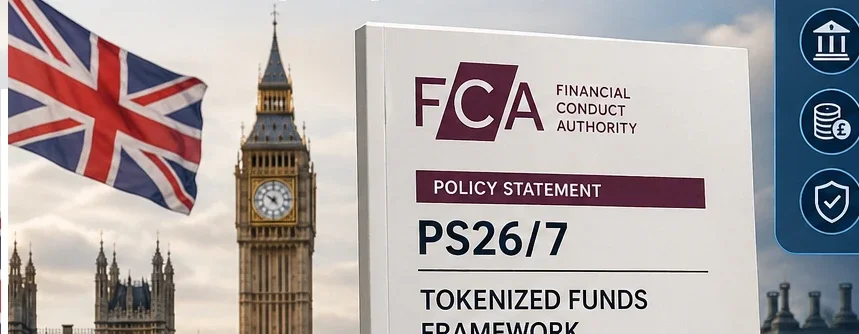
The United Kingdom is advancing its digital asset strategy by formally integrating tokenized funds into its existing regulated fund framework, marking a significant step toward mainstream adoption of blockchain-based financial infrastructure. Under new guidance issued in policy statement PS26/7 by the Financial Conduct Authority, authorized funds can now utilize distributed ledger technology (DLT) to maintain investor records and execute fund operations, provided they meet strict regulatory and operational resilience standards.
This policy enables firms to treat onchain transaction records as the primary register of ownership, removing the requirement for fully duplicated offchain systems in certain cases. However, this flexibility is contingent on robust contingency planning to ensure data integrity, system continuity, and investor protection. The FCA’s approach reflects a deliberate effort to incorporate innovation within the existing regulatory perimeter rather than allowing parallel, less-regulated systems to emerge.
A central component of the framework is the introduction of the optional direct-to-fund (D2F) dealing model. This structure allows funds or their appointed depositaries to directly issue or cancel units in response to investor subscriptions and redemptions. By eliminating intermediated steps typically handled by fund managers, the D2F model simplifies transaction flows and improves operational efficiency, particularly when integrated with onchain settlement mechanisms.
The FCA also confirms that tokenized fund structures can operate across public blockchain networks, provided that investor rights, fee structures, and legal protections remain consistent regardless of the underlying technology. This includes the possibility of issuing fund units across multiple blockchains, as long as compliance controls and governance standards are maintained.
Importantly, the regulator signals openness to the future use of digital cash and stablecoins for settlement and fund-related expenses, subject to further regulatory approvals and safeguards. This aligns with broader global trends where stablecoins are increasingly viewed as viable settlement instruments in financial markets.
The policy builds on earlier initiatives outlined in the UK’s digital assets roadmap and reflects ongoing collaboration between regulators, asset managers, and technology providers. It also follows the FCA’s recent consultations on a comprehensive cryptoasset regulatory regime, which will cover areas such as issuance, trading, custody, and staking. The full framework is expected to be implemented by October 2027.
From a market perspective, the move is expected to enhance the efficiency, transparency, and accessibility of fund operations. Tokenization can reduce settlement times, lower operational costs, and enable more flexible ownership structures. At the same time, the FCA emphasizes that these benefits must not come at the expense of investor protection, which remains a core regulatory priority.
The policy also reflects a broader shift in the financial industry, where digital assets are transitioning from speculative instruments to practical infrastructure components. As highlighted during events such as Consensus 2026, institutional focus is increasingly centered on real-world applications, including tokenized government securities, private credit, and other real-world assets.
Looking ahead, the FCA outlines a phased evolution from tokenized funds toward fully tokenized asset ecosystems, including programmable cash flows and smart contract-based fund administration. Future consultations planned for 2026 will further explore the role of DLT in wholesale financial markets, reinforcing the UK’s ambition to remain a leading global hub for digital finance innovation.
In summary, policy statement PS26/7 provides a structured and compliant pathway for integrating tokenization into mainstream fund management. By balancing innovation with regulatory oversight, the UK is positioning itself to harness the efficiencies of blockchain technology while maintaining high standards of market integrity and investor protection.
Source: https://tradersunion.com/news/financial-news/show/