US Treasury Seizes $500M in Iranian Crypto Assets, Expands Sanctions to Disrupt Oil Revenue and Financial Networks Linked to Tehran
Operation targets wallets, banks, and oil buyers, combining blockchain analysis and secondary sanctions to limit Iran’s global financial access
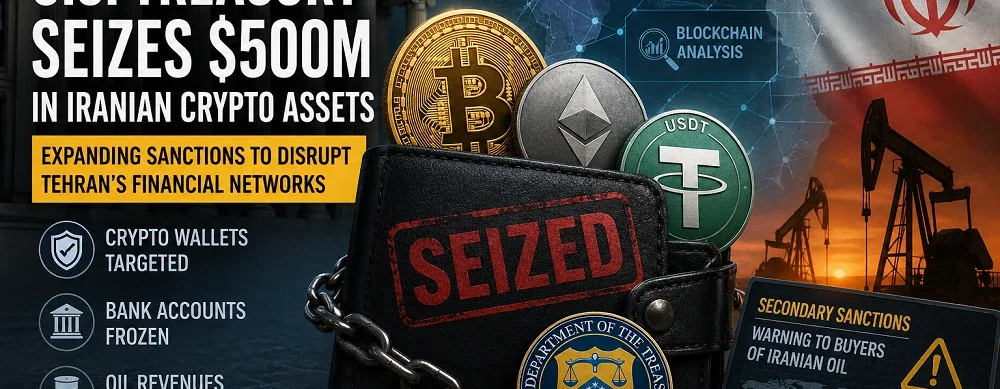
The U.S. Department of the Treasury has intensified its economic pressure campaign against Iran, seizing nearly $500 million in crypto-related assets, according to Treasury Secretary Scott Bessent. Speaking publicly, Bessent outlined that the initiative—referred to as Operation Economic Fury—aims to systematically disrupt Tehran’s financial infrastructure by targeting digital assets, restricting oil revenues, and isolating the country from global financial systems.
The campaign combines traditional financial enforcement with advanced blockchain tracking. Measures include freezing bank accounts, seizing overseas holdings, and applying diplomatic pressure on foreign governments and private companies to cut financial ties with Iran. The broader objective is to weaken the state’s ability to fund military operations and regional proxy networks, which U.S. officials consider a national security concern.
A significant portion of the recent enforcement activity focused on cryptocurrency. The Treasury previously moved to freeze approximately $344 million in digital assets linked to Iranian entities. These funds were largely held in USDT, a widely used stablecoin issued by Tether. The action was carried out in coordination with blockchain analytics firm Chainalysis, highlighting increasing collaboration between government agencies and private-sector firms in monitoring illicit financial flows.
According to officials familiar with the investigation, the targeted wallets were connected to transactions involving Iranian cryptocurrency exchanges and intermediary addresses tied to entities associated with the Central Bank of Iran. This indicates a structured network designed to bypass traditional sanctions using digital assets, which are harder to trace without specialized tools.
Bessent emphasized that the administration’s strategy extends beyond crypto enforcement. The Treasury has issued warnings to international buyers of Iranian oil, stating that the U.S. is prepared to impose secondary sanctions on companies, financial institutions, and industries that facilitate or support Iran’s oil exports. These measures are intended to further limit the country’s primary source of revenue and increase economic pressure on the government.
The approach reflects a broader shift in sanctions policy, where digital assets are now a central focus alongside banking and trade restrictions. U.S. authorities argue that integrating blockchain intelligence into enforcement frameworks improves their ability to detect, trace, and freeze illicit funds in near real time.
Overall, Operation Economic Fury represents a multi-layered strategy combining financial sanctions, international cooperation, and technological capabilities. By targeting both traditional and emerging financial channels, the U.S. aims to constrain Iran’s economic activity and reduce its capacity to operate within the global financial system.
Source: https://cryptobriefing.com/iran-crypto-sanctions-s