Meta and Visa Expand Stablecoin Payments via USDC Across Global Blockchain Networks, Enhancing Cross-Border Digital Financial Infrastructure
Meta launches USDC payouts through Stripe on Polygon and Solana while Visa expands stablecoin settlements across multiple blockchain ecosystems worldwide
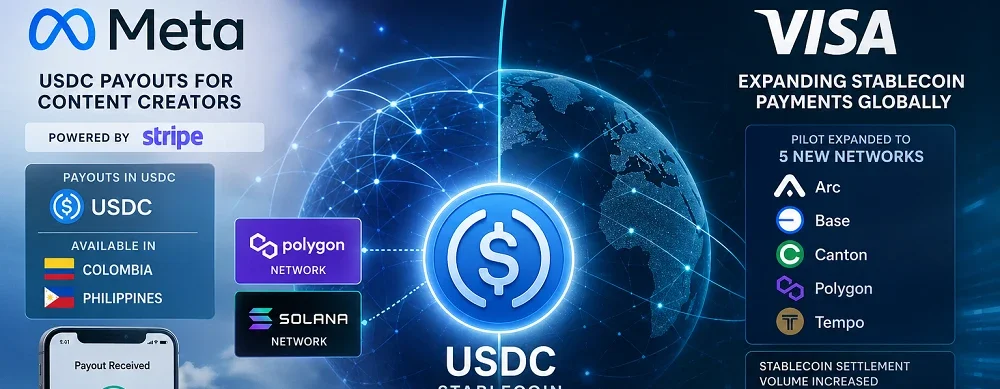
**Meta Corporation** has launched stablecoin payouts for content creators, enabling payments in USD Coin through wallets operating on the Polygon and Solana networks. The initiative is being implemented in partnership with Stripe, which acts as the payment provider and settlement infrastructure partner.
At the initial stage, the new payout option is available to creators in Colombia and the Philippines. The launch reflects growing institutional interest in stablecoin-based payment systems, particularly for cross-border settlements where traditional payment rails often involve higher costs and longer processing times.
According to Meta, because settlements in stablecoins are tied to blockchain-based assets, users will receive specialized reporting from Stripe covering cryptocurrency transactions. The company advised participants to maintain a complete transaction history for tax compliance and financial reporting purposes. This recommendation highlights one of the operational realities of digital asset payments: transparency and recordkeeping remain essential for regulatory and tax obligations.
Reports about Meta’s renewed interest in stablecoin infrastructure first emerged in February 2026. Beyond integrating a third-party provider for dollar-denominated token settlements, the company is reportedly working on its own digital wallet product. Such a wallet could provide creators and users with direct access to blockchain-based balances, simplifying transfers and potentially expanding financial functionality within Meta’s ecosystem.
This move marks a notable return to blockchain payments for Meta. In 2019, the company, then operating under the name Meta Platforms, introduced the Libra project — a proposed global stablecoin intended to support international payments. Alongside Libra, Meta developed Calibra, a digital wallet designed for storing and transferring the token. However, both initiatives faced significant regulatory resistance from governments and financial authorities, ultimately forcing the company to discontinue the effort.
The current strategy differs significantly from Libra. Instead of issuing its own stablecoin, Meta is relying on an established third-party digital dollar asset and regulated payment infrastructure. This approach may reduce regulatory friction while allowing the company to participate in the expanding digital payments sector.
At the same time, Visa continues expanding its own stablecoin payment infrastructure. The company announced that its pilot stablecoin settlement system is now being extended to five additional blockchain networks: Arc, Base, Canton, Polygon, and Tempo. Previously, the pilot only supported Avalanche, Ethereum, Solana, and Stellar.
Visa reported that its stablecoin settlement volume increased by 50% quarter-over-quarter, reaching $7 billion. The growth indicates rising adoption of blockchain-based payment rails by financial institutions and enterprise clients seeking faster and more cost-efficient transaction settlement mechanisms.
Company representatives said that integrating additional blockchain ecosystems is part of Visa’s broader strategy to unify payment processing within a standardized infrastructure. The goal is to enable interoperability across multiple blockchain networks while maintaining compliance with financial regulations.
Visa’s stablecoin pilots have been active for several years and are now operational across Latin America, the Caribbean, Europe, Asia-Pacific, Central Europe, the Middle East, and Africa. In November 2025, Visa expanded its services by enabling USDC payments through American banking partners, signaling deeper integration between traditional finance and blockchain-based settlement systems.
Further strengthening its digital asset strategy, Visa announced on April 28 a partnership with WeFi, a fintech founded by Reeve Collins. The collaboration is focused on developing cryptocurrency payment solutions and expanding on-chain banking infrastructure.
The parallel initiatives by Meta and Visa demonstrate a broader trend: major global payment and technology companies are increasingly adopting stablecoins as practical tools for real-world financial operations. While regulatory scrutiny remains a critical factor, the growing use of blockchain-based dollars suggests stablecoins are becoming an increasingly important component of the modern payments ecosystem.
Source: https://forklog.com/en/meta-initiates-usdc-payment