Fraudsters demand crypto payment for vessel passag
Ships are being sent fake payment demands in crypt
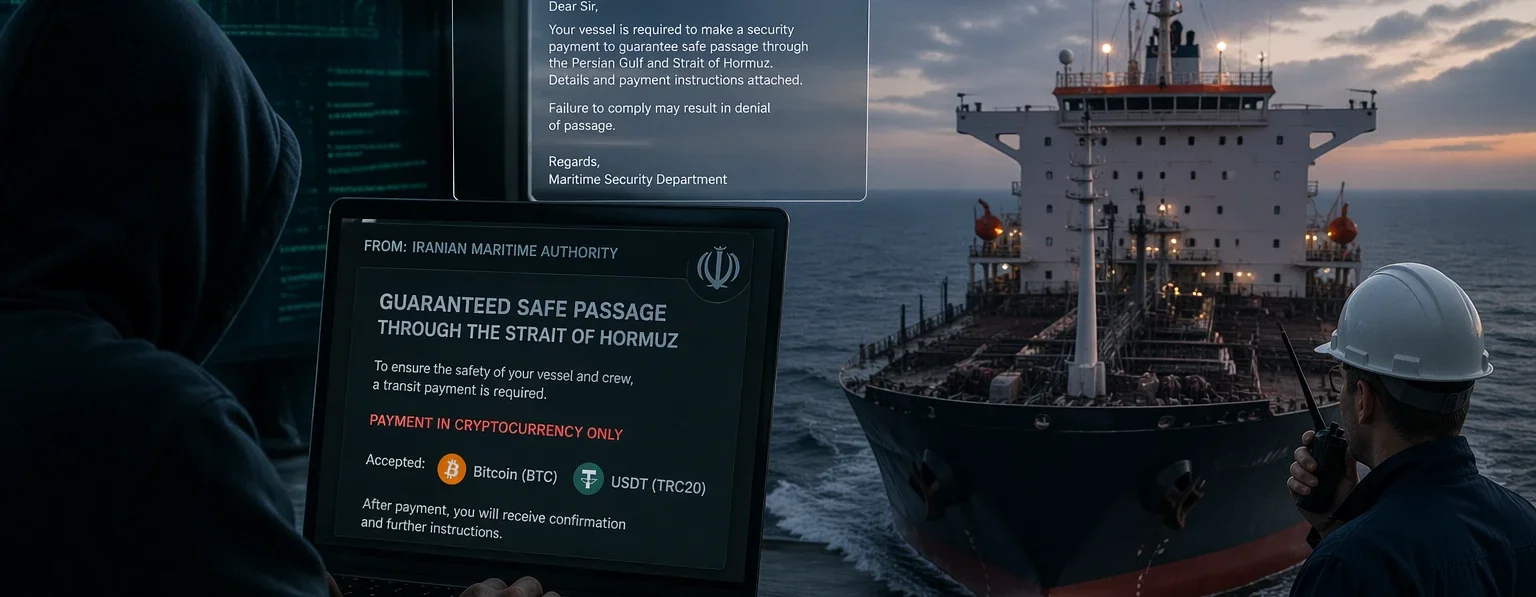
The Greek company specializing in maritime risk management, Marisks, has recorded an increase in fraudulent activity targeting shipping companies operating in the area of the Strait of Hormuz — one of the key global oil supply routes.
According to the company, shipowners have begun receiving messages from attackers posing as Iranian official authorities. These messages offer a “guaranteed safe passage” through the strait in exchange for payment in cryptocurrency, most often in bitcoin or USDT. Such demands are accompanied by instructions for transmitting vessel data and making further payment, supposedly after “verification” by security services.
Marisks separately emphasizes that such messages have no connection to real Iranian government authorities and are fraudulent. The company urges market participants not to engage with such requests and to verify any similar notifications through official channels.
The situation is exacerbated by the tense environment in the region. Since the end of February, traffic through the Strait of Hormuz has been significantly restricted amid a military conflict involving the United States and Israel. As a result, a large number of tankers and cargo vessels have accumulated in the Persian Gulf, waiting for an opportunity to pass through the strategic route. Limited access to the strait creates increased risks and intensifies pressure on shipping companies, making them more vulnerable to fraudulent schemes.
According to available data, at least one vessel may have fallen victim to such deception. After complying with the attackers’ demands, the vessel attempted to pass through the strait and came under fire. This incident highlights the potentially serious consequences of trusting unverified sources of information in crisis conditions.
An additional factor that may have contributed to the emergence of such schemes is the discussion at the official level of introducing fees for passage through the strait using cryptocurrency. Previously, representatives of the Iranian side had considered the possibility of collecting such payments. Fraudsters likely use this information to give their demands an appearance of legitimacy.
Experts note that such schemes combine elements of social engineering and the current geopolitical agenda. Attackers rely on the fact that in conditions of uncertainty and limited access to verified information, shipping companies will act more quickly and less critically assess incoming requests.
From a risk management perspective, such incidents require strengthening information verification procedures, especially when it comes to financial operations or vessel safety. It is recommended to use only official communication channels, confirm any demands through multiple independent sources, and avoid urgent payments without full verification.
It is also important to consider that cryptocurrency payments in such schemes are not used случайно. They make it difficult to trace funds and recover money, which makes them a convenient tool for fraudsters. Therefore, any requests for payment in digital assets, especially in non-standard situations, should be treated with increased caution.
Under current conditions, shipping companies need to pay special attention to cybersecurity and personnel training. Awareness of such schemes and clear internal response protocols can significantly reduce the likelihood of a successful attack.
Thus, the scheme recorded by Marisks is an example of how geopolitical instability and technological tools can be used by attackers for profit. The key protection in such situations remains critical evaluation of information, strict verification procedures, and refusal to make hasty decisions in matters related to safety and finances.
Source: https://www.coindesk.com/business/2026/04/21/crypt